
Most American offices and households still believe laser printers belong only in large corporate spaces, yet nearly half of IT decision-makers misunderstand basic facts about this technology. With the demand for fast, reliable printing growing, separating myth from reality is more important than ever. This guide unpacks widespread misconceptions about laser printers and highlights the surprising features making them a practical, efficient choice for both professional and personal use.
| Point | Details |
|---|---|
| Modern Laser Printers are Accessible | Laser printers are not limited to corporate environments and are now feasible for small businesses and home offices. |
| Cost-Effectiveness | Laser printers generally have a lower cost per page, making them more economical for high-volume printing needs. |
| Advanced Functionalities | Contemporary models come with wireless connectivity and multifunction capabilities, enhancing productivity for users. |
| Common Misconceptions | There are prevalent myths regarding the complexity and environmental impact of laser printers that need to be addressed. |
A laser printer represents a sophisticated printing technology that uses precise digital imaging techniques to transfer text and graphics onto paper. As defined by Merriam-Webster, a laser printer is a high-resolution printer that creates computer output images xerographically through laser technology.
Contrary to popular belief, laser printers are not just complex machines found in large corporate environments. Modern laser printers have become increasingly accessible for small businesses and home offices. Research indicates that 47% of IT decision-makers still harbor misconceptions about laser printer technology, particularly regarding their environmental sustainability and operational efficiency.
Key characteristics that distinguish laser printers from traditional inkjet models include superior print speed, exceptional text clarity, and lower per-page printing costs. While many assume laser printers are exclusively monochrome, contemporary models offer vibrant color printing capabilities with professional-grade results. These devices utilize advanced electrostatic technology, precisely controlling laser beams to create crisp, consistent images through a complex process of charging, imaging, and transferring toner onto paper.
Common misconceptions about laser printers often revolve around perceived complexity, high initial costs, and environmental impact. However, modern laser printer designs have significantly improved energy efficiency, reduced operational noise, and become more compact. Small businesses can now leverage these powerful printing solutions without significant infrastructure investments, making laser printers a strategic choice for organizations seeking reliable, high-quality document production.
Laser printer technology offers diverse options tailored to specific business and office needs. According to research, laser printers can be categorized into several distinct types, each designed to address unique printing requirements for Canadian offices and professionals.
The primary classifications of laser printers include monochrome and color variants. Monochrome laser printers excel at producing crisp black-and-white documents efficiently, making them ideal for text-heavy materials like reports, contracts, and internal communications. Computerguideonline highlights that these printers are particularly cost-effective for text document production, offering significant savings for budget-conscious organizations.
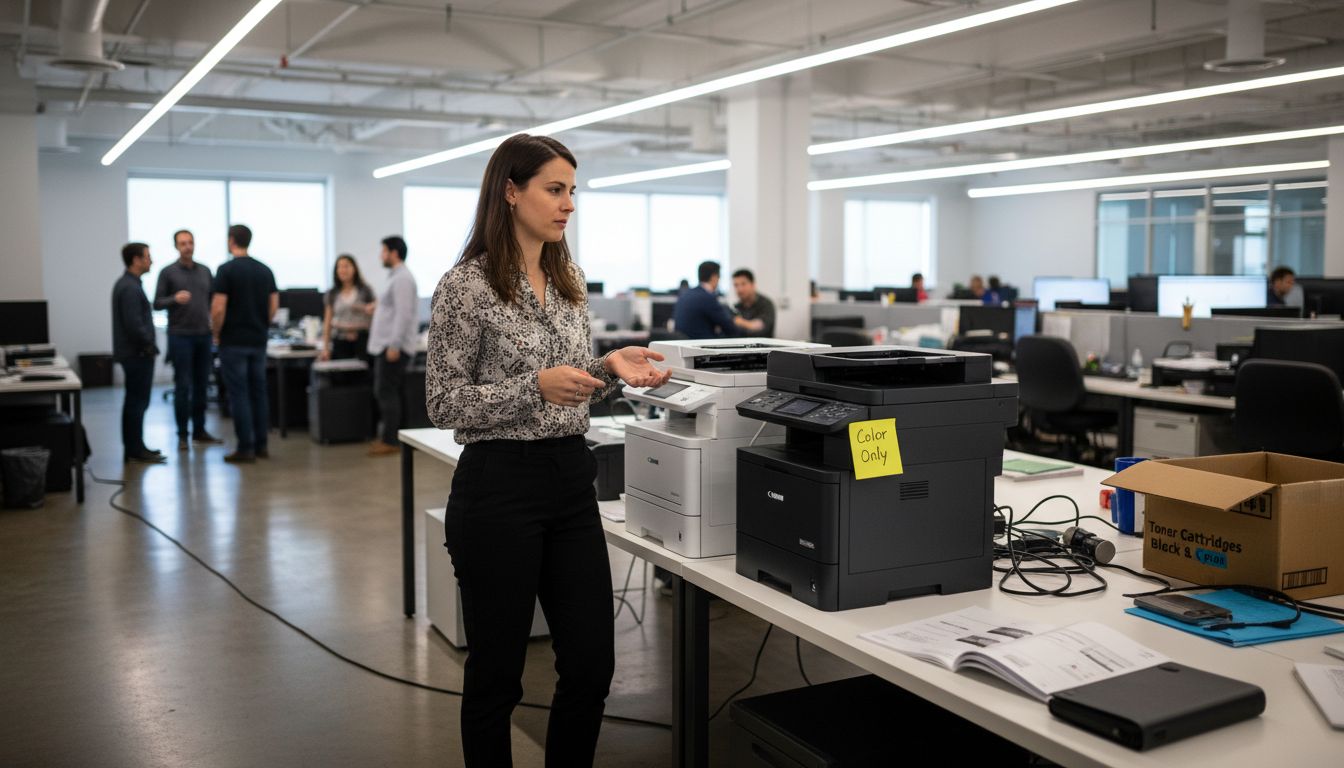
Beyond basic color distinctions, laser printers now feature advanced configurations such as wireless models, network-enabled devices, and multifunction systems. These sophisticated machines combine printing with scanning, copying, and sometimes faxing capabilities. Wireless laser printers like the HP LaserJet Pro 4001dw Monochrome Wireless Laser Printer provide seamless connectivity, allowing multiple users to print from various devices without complex cable management.
Modern laser printer technologies cater to different volume requirements, ranging from compact desktop models for small offices to high-volume systems designed for large enterprises. Key considerations when selecting a laser printer include print speed, monthly duty cycle, resolution quality, and connectivity options. Small businesses might prioritize compact, versatile models, while larger organizations may need robust network printers capable of handling extensive printing demands with consistent performance and reliability.
Laser printing represents a sophisticated digital imaging process that transforms electronic data into crisp, high-quality printed documents. According to research, laser printers create images through a complex electrostatic process involving precise electronic and mechanical interactions that ensure exceptional print quality.
The fundamental mechanism begins with a photoconductive drum, a critical component that receives an electronic charge and acts as a canvas for image creation. When a document is sent to print, a laser beam precisely scans across this drum, selectively neutralizing specific areas and creating an electrostatic template of the intended image. Toner particles, which are fine powder containing pigments, are then attracted to these charged areas, effectively mapping out the text or graphic to be printed.
The printing sequence continues as the paper passes through the printer, where the toner is transferred onto the page and then permanently bonded through intense heat and pressure in a process called fusing. This method ensures that printed materials are smudge-resistant and durable. The HP TerraJet 210A Original LaserJet Toner Cartridge exemplifies the precision engineering behind modern laser printing consumables.
Key advantages of this technological approach include remarkable print consistency, high-speed output, and superior image resolution compared to traditional inkjet methods. The electrostatic printing process allows for incredibly sharp text and graphics, with most laser printers capable of producing documents at resolutions ranging from 600 to 2400 dots per inch. This makes laser printers particularly well-suited for professional environments requiring crisp, professional-looking documents with repeatable quality across multiple print runs.
Laser printers have revolutionized document production with their remarkable efficiency and versatility, making them an essential technology for both home offices and professional environments. Research indicates that these devices offer significant advantages in speed and performance, delivering exceptional printing capabilities that meet diverse user needs.
The cost-effectiveness of laser printers stands out as a primary benefit for budget-conscious users. Unlike inkjet alternatives, laser printers produce documents at a dramatically lower cost per page, with some models capable of printing up to 55 pages per minute. Comprehensive printing solutions like the Brother MFC-L2750DW demonstrate the multifunctional capabilities modern laser printers offer, including duplex printing, automatic document feeding, and network connectivity.
Key advantages for home and business users include rapid print speeds, superior image quality, and long-term durability. Laser printers excel in environments requiring consistent, high-volume printing, with robust mechanisms that can handle extensive workloads without frequent maintenance. The HP LaserJet Pro 4001n Monochrome Laser Printer represents the kind of reliable technology that meets professional standards while remaining accessible to smaller organizations.
Beyond basic printing functionality, modern laser printers offer advanced features that enhance productivity. These include wireless connectivity, mobile printing options, secure printing protocols, and energy-efficient designs. Small businesses and home offices can leverage these technologies to streamline document workflows, reduce operational costs, and maintain professional-quality print output across various document types and formats.
Choosing between laser and inkjet printers involves a nuanced analysis of upfront costs, operational expenses, and long-term performance characteristics. While laser printers typically have higher initial purchase prices, they often provide more economical printing solutions for consistent, high-volume document production.
Research challenges common assumptions about printer sustainability and cost-effectiveness, revealing that many businesses hold misconceptions about the true economic implications of their printer technology. Inkjet printers, often overlooked, can offer surprising advantages in specific usage scenarios, particularly for organizations with intermittent printing needs.
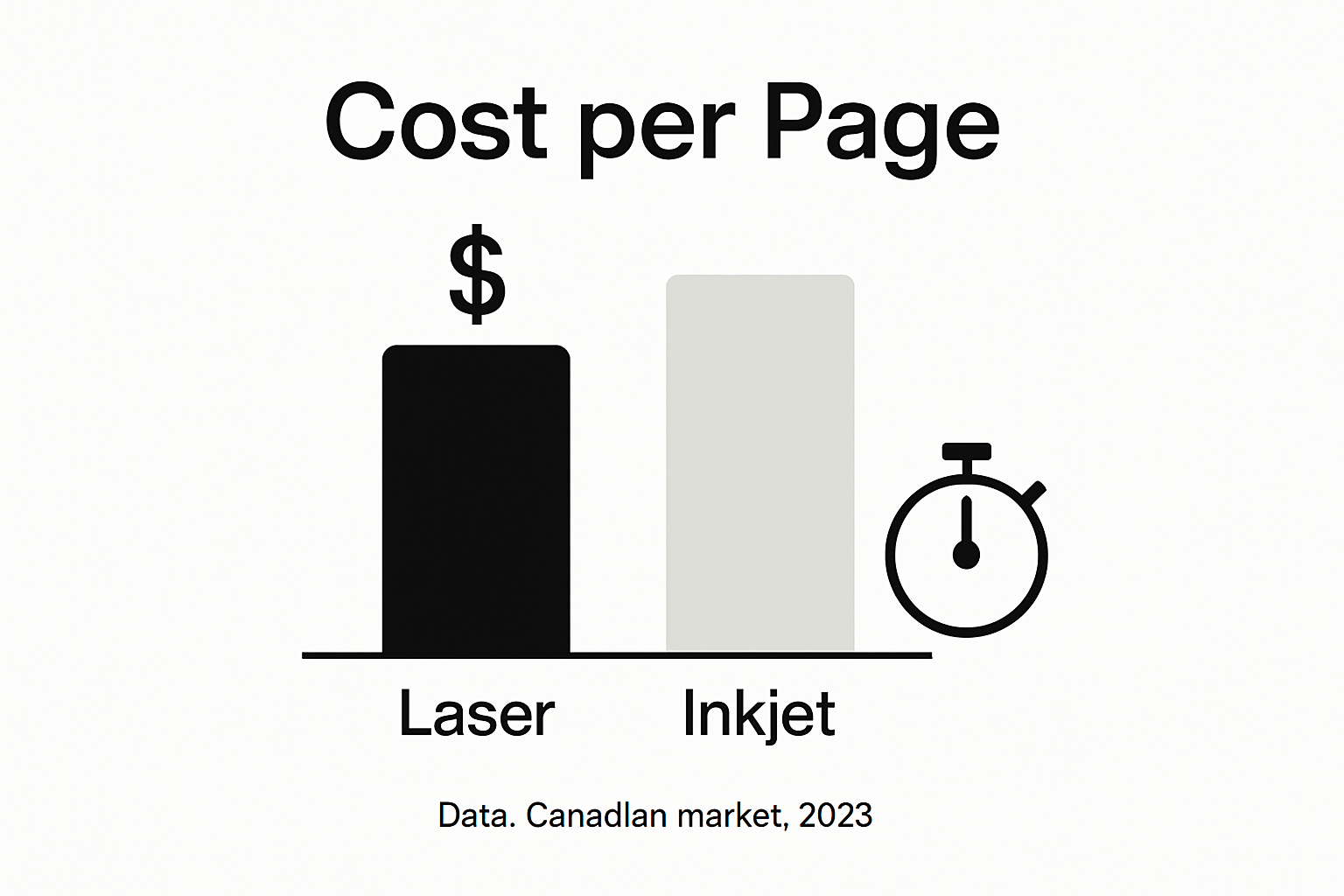
The cost per page represents the most critical metric for comparing printer technologies. Laser printers generally demonstrate lower per-page printing costs for text-heavy documents, with toner cartridges producing significantly more pages compared to ink cartridges. Analysis from industry studies suggests that businesses should carefully evaluate their specific printing requirements before making a definitive technology selection.
Beyond direct printing expenses, organizations must consider additional factors such as energy consumption, maintenance requirements, and replacement frequency. While laser printers excel in high-volume environments, inkjet technologies have evolved to provide more efficient options for smaller operations. The HP vs Xerox: Which Printer Brand Should You Buy in 2025? article offers deeper insights into navigating these complex technological trade-offs, helping Canadian businesses make informed printer investment decisions.
Choosing the right laser printer means balancing speed, quality, and cost efficiency—all key challenges highlighted in the article. Whether you are managing high-volume printing or striving for professional-grade documents, frustration with expensive toner replacements or slow print speeds can disrupt productivity. You need a trusted source that understands these goals and offers affordable, high-quality equipment and supplies that fit your office demands.
Experience the power of advanced laser technology with GetToner.ca Your one-stop shop for competitive prices on OEM and compatible toner cartridges, printers, and multifunction devices tailored for Canadian home and business users. Benefit from free shipping on orders over $100 and enjoy exclusive discounts that make switching to or upgrading your laser printer even more cost-effective.
Discover the difference quality makes with top brands like HP and Brother and seize the opportunity to enhance your workflow today. Don’t wait for printing problems to slow you down. Visit our store now to find the perfect laser printer and supplies that match your needs and keep your office running smoothly.
Laser printers are cost-effective, offer high-speed printing, superior image quality, and long-term durability, making them suitable for environments requiring consistent, high-volume document production.
Laser printing uses a photoconductive drum that receives an electronic charge. A laser beam scans the drum, neutralizing specific areas to create an electrostatic template. Toner is then attracted to these areas, transferred onto paper, and fused permanently through heat and pressure.
Laser printers come in various types, including monochrome printers designed for black-and-white documents and color printers that provide vibrant printing capabilities. There are also multifunction models that include scanning and copying features, as well as wireless and network-enabled options for improved connectivity.
While laser printers generally have higher initial purchase prices, they offer lower per-page printing costs, especially for text-heavy documents. Toner cartridges in laser printers typically yield more pages than ink cartridges, making laser printers more economical for high-volume printing needs.