
Over 90 percent of American households own at least one printer, yet most people remain unsure about the differences between laser and inkjet technology. Choosing the right printer affects cost, print quality, and how efficiently you handle daily tasks. By understanding the unique principles behind these essential printing types, you can make smarter decisions that fit your home or business needs and avoid common mistakes that waste both time and money.
| Point | Details |
|---|---|
| Laser Printers are Cost-Effective for High Volume | Laser printers have a higher initial cost but lower per-page printing expenses, making them ideal for businesses requiring frequent document production. |
| Inkjet Printers Excel in Color Quality | Inkjet printers are better suited for high-quality photo and graphic printing due to their superior color reproduction capabilities. |
| Consider Application Needs Before Purchase | Determine whether you need a printer for text-heavy documents or creative projects, as this greatly influences the choice between laser and inkjet printers. |
| Maintenance and Longevity Factors Matter | Laser printers generally require less maintenance and have a longer lifespan, while inkjet printers may incur higher long-term costs due to frequent cartridge replacements. |
Printing technologies have evolved dramatically, with laser and inkjet printers representing two fundamental approaches to transforming digital documents into physical copies. Foundational printing research reveals distinct mechanisms that define how these technologies operate, each with unique strengths and applications.
Laser printers utilize electrostatic technology to transfer toner onto paper through a precise sequence of steps. An electrostatic drum captures a digital image, attracts toner particles, and then transfers them onto paper using heat and pressure. These printers excel at producing sharp, consistent text and graphics, making them ideal for high-volume office environments that require rapid, professional-quality document production.
In contrast, inkjet printers function by precisely spraying microscopic ink droplets directly onto paper. These printers use tiny nozzles that can produce incredibly detailed color images, particularly suited for photography and graphic design work. Advanced droplet formation techniques allow modern inkjet printers to create remarkably intricate prints with nuanced color gradations and exceptional visual depth.
The core differences between laser and inkjet technologies translate into distinct performance characteristics:
Laser Printers
Inkjet Printers
Modern printing technologies represent sophisticated systems that transform digital information into tangible documents through complex mechanical processes. Advanced laser printing mechanisms involve a remarkable sequence of electronic and physical interactions that enable precise document reproduction.
In laser printers, the process begins with digital data transmission. A laser beam scans an electrically charged drum, creating an electrostatic image that attracts toner particles. The drum then transfers these particles onto paper, which is heated and pressed to create a permanent image. This electrostatic approach allows laser printers to produce crisp, high-resolution text and graphics with remarkable speed and consistency.
Inkjet printing technology operates through a fundamentally different mechanism. Tiny nozzles spray microscopic ink droplets directly onto paper, creating images through precise dot placement. These printers can produce incredibly detailed color prints by manipulating droplet size, density, and placement. Modern inkjet systems use advanced print head technologies that enable multiple ink colors to be combined with exceptional precision.
The core operational differences between these technologies result in distinct performance characteristics:
Laser Printer Operation
Inkjet Printer Operation
Print technology represents a critical consideration for users seeking optimal document reproduction. Comprehensive printer performance comparisons reveal nuanced differences between laser and inkjet technologies that dramatically impact printing outcomes.
Laser printers excel in text-based document production, delivering consistently sharp black and white prints with remarkable speed. Their electrostatic printing mechanism enables rapid page production, typically ranging from 15 to 50 pages per minute for standard office models. These printers shine in high-volume environments where crisp text and quick turnaround are paramount, making them ideal for professional settings that require extensive document processing.

Advanced printer technology research demonstrates that inkjet printers offer superior color reproduction and image quality. These devices leverage precision ink droplet placement to create nuanced, photorealistic prints with exceptional color depth and detail. While typically slower than laser printers, inkjet models provide unparalleled visual quality for photographs, graphic design work, and high-resolution color documents.
The key performance differences between these printing technologies can be summarized as follows:
Laser Printer Strengths
Inkjet Printer Strengths
Printer ownership involves far more than the initial purchase price. Comprehensive printer cost analysis reveals a complex financial landscape where upfront expenses and long-term maintenance dramatically impact total investment.
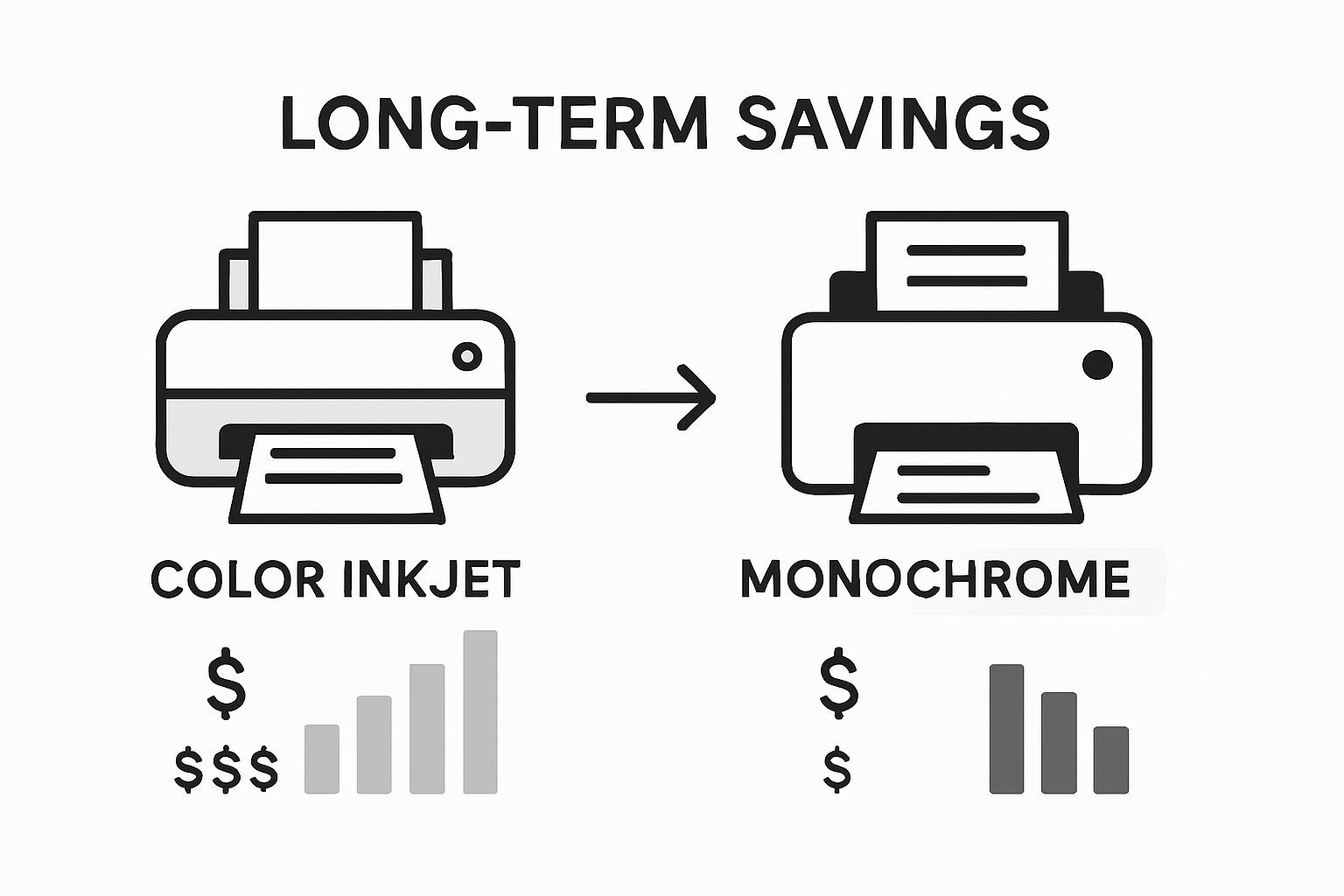
Laser printers typically require a higher initial investment but demonstrate significant long-term cost efficiency. Their toner cartridges, while more expensive to purchase, produce substantially more pages per unit compared to inkjet ink cartridges. A standard laser toner cartridge might print 2,000 to 3,000 pages, whereas an inkjet cartridge often yields only 200 to 500 pages. This efficiency translates to lower per-page printing costs, making laser printers more economical for high-volume printing environments.
Total printer ownership research highlights the nuanced expenses associated with different printing technologies. Inkjet printers feature lower upfront costs but incur higher recurring expenses through frequent cartridge replacements. Additionally, inkjet printers are more prone to maintenance issues like print head clogging, which can lead to unexpected repair costs and reduced printer lifespan.
Key cost considerations for potential printer buyers include:
Laser Printer Cost Factors
Inkjet Printer Cost Factors
Printer selection requires understanding the unique strengths of different printing technologies. Comprehensive printer usage analysis reveals distinct scenarios where laser and inkjet printers excel in home and professional environments.
Laser printers are the gold standard for business settings that demand high-volume, consistent document production. Their rapid printing speeds, typically ranging from 20 to 50 pages per minute, make them ideal for office environments with extensive paperwork. Legal firms, academic institutions, and corporate departments benefit most from laser printer capabilities, particularly when producing text-heavy documents like reports, contracts, and academic papers.
Printer technology application research demonstrates that inkjet printers shine in creative and home-based environments. Photographers, graphic designers, and home users seeking high-quality color reproduction find inkjet printers perfectly suited to their needs. These devices deliver exceptional image quality, making them ideal for printing photographs, artwork, greeting cards, and marketing materials that require nuanced color gradation and detailed visual representation.
Key application recommendations include:
Business Laser Printer Applications
Home and Creative Inkjet Printer Applications
Choosing between laser and inkjet printers can feel overwhelming with so many factors like print quality, speed, cost, and application to consider. Whether you want fast, durable text printing with laser technology or rich, vibrant color output with inkjet printers, it is crucial to find supplies and equipment that match your specific goals and budget. Key challenges include managing the cost of cartridges and maintenance while ensuring reliable, high-quality prints for home or business use.
Take control of your printing needs now at GetToner.ca, your trusted Canadian source for competitively priced OEM and compatible ink and toner cartridges, printers, and multifunction devices. Benefit from free shipping on orders over $100 and special seasonal promotions that make upgrading affordable. Explore our selection of Printers and Multifunction Devices to find options tailored for both high-volume laser printing and premium inkjet quality. Shop today and enjoy fast, local support with a seamless online experience designed specifically for Canadian users. Make the smart choice with GetToner.ca and print confidently without compromise.
Laser printers use electrostatic technology to print text and images quickly and efficiently, making them ideal for high-volume document production. Inkjet printers spray tiny droplets of ink directly onto paper, excelling in color reproduction and detail, which makes them suitable for photo printing and graphic design.
Laser printers are better for high-volume printing due to their faster printing speeds and lower cost per page for text documents. They are designed to handle large quantities of prints efficiently, making them ideal for office environments.
Laser printers generally offer faster print speeds and are better at producing sharp, clear text. Inkjet printers provide superior color reproduction and detail, especially for photographs and graphics, but they usually print slower than laser models.
Laser printers typically have a higher initial price but lower long-term costs due to their toner cartridges, which print more pages per cartridge compared to inkjet cartridges. While inkjet printers may have lower upfront costs, they tend to have higher per-page printing expenses and require more frequent cartridge replacements.